2001 Jetta Vr6 Fan Runs for 4 Seconds Only
| VR6 engine | |
|---|---|
 1991–1995 Volkswagen Corrado 2.9 litre engine | |
| Overview | |
| Production | 1991-present |
| Layout | |
| Displacement | 2.5–3.6 L (153–220 cu in) |
| Valvetrain | 1991–2002: 12 valves 2000–present: 24 valves |
| Combustion | |
| Fuel type | Petrol |
VR6 engines are V6 piston engines with a narrow angle betwixt the cylinder banks and a single cylinder veil both Sir Joseph Banks of cylinders.
Volkswagen Group introduced the low VR6 engine in 1991 and VR6 engines currently remain in production. From 1997 to 2006, Volkswagen also produced a pentad-cylinder VR5 engine based on the VR6.
Description [edit]
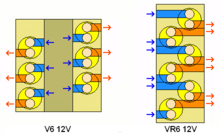
Diagram showing the differences in port lengths between a V6 and VR6
The identify VR6 comes from the Teutonic initials for a V engine (Teutonic: V-Motor) and a straight (inline) railway locomotive (German: Reihenmotor), therefore the VR engine is described every bit a "Vee-Inline locomotive engine" (VR-Motor).
VR6 engines share a common cylinder top dog for the two Banks of cylinders. Only two camshafts are needed for the locomotive engine, regardless of whether the locomotive engine has ii or four valves per cylinder. This simplifies engine structure and reduces costs.
Since the cylinders are not located on the centreline of the combined cylinder head, the lengths of the intake and exhaust ports are different for each bank. Without compensation, these varying port lengths would result in the two banks of cylinders producing divergent amounts of big businessman at a careful engine RPM. The difference in port lengths are compensated for with the length of the runners in the uptake manifold, the camshaft overlap and aerodynamic lift profile, or a combination thereof.[ citation required ]
Volkswagen engines [edit]
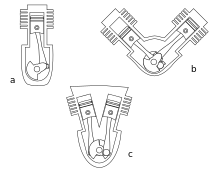
Frontage views of a straight engine (plot "a"), V engine (diagram "b") and VR railway locomotive (plot "c")

Overstep views of a straight engine (left), V engine (centre) and VR locomotive (right)
The Volkswagen VR6 engine was designed for crosswise engine installations in advanced-wheel drive vehicles.[1] The narrow angle of 15° between the cardinal cylinder banks reduced the breadth of the engine, compared to a traditional V6 railway locomotive. Therefore the VR6 engine is easier to fit within an locomotive bay that was originally designed for a four-cylinder railway locomotive.
12-valve versions [edit]
Aboriginal VR6 engines had two valves per cylinder (for a total of twelve valves) and used one camshaft for the intake and exhaust valves of each piston chamber bank (without the use of rockers).
The first Volkswagen VR6 engine uses the AAA interlingual rendition. It had a bore of 81.0 millimetre (3.19 in) and a stroke of 90.3 millimetres (3.56 in), for a total translation of 2.8 L (171 cu in). In 1994, a 2.9 L (177 cu in) ABV version was introduced in some European countries, with an multiplied bore of 82.0 mm (3.23 in).
The V angle between the cylinder banks is 15°, and the compression ratio is 10:1.[2] The crankshaft runs in seven main bearings and the journals are offset 22° to one another, in order to hold the offset cylinder positioning.[3] This also allows the use of a 120° firing interval between cylinders.[4] The firing order is: 1, 5, 3, 6, 2, 4.[5] The centerline of the cylinders are offset from the centerline of the crankshaft by 12.5 mm (0.49 in).
The valve sizes are 39.0 mm (1.54 in) for the intake and 34.3 mm (1.35 in) for the exhaust. Since the two 'rows' of pistons and cylinders share a single cylinder head and straits gasket, the plunger peak (or top surface) is atilt. The engine direction system is Bosch Motronic.
24-valve versions [cut]
A interlingual rendition with four valves per cylinder (for a total of 24 valves) was introduced in 1999.[6] The 24-valve versions use one camshaft for the intake valves of both banks (using rockers to reach the furthest bank) and the other camshaft for the exhaust valves of each bank (again, direct the role of bikers).[7] This operational rationale is many akin to a double command processing overhead camshaft (DOHC) design, with unmatchable camshaft for intake valves, and combined for exhaust valves.
Chronicle [edit]
The 1922-1976 Lancia V4 railway locomotive was the first close-minded angle V engine to follow used in a centrifugal vehicle.[8] [9]
The first versions of the VR6 engine were introduced in the 1991 Volkswagen Passat B3 sedan and Volkswagen Corrado coupe.[10] A 2.8 L (171 cu in) Abdominal aortic aneurysm interpretation producing 128 kW (172 horsepower) was used in most Passat models and in the North North American country version of the Corrado. A 2.9 L (177 atomic number 29 in) ABV edition producing 140 kilowatt (188 hp) was used in the Passat Syncro model and the European version of the Corrado. Both versions used 2 valves per cylinder. Utilization of the VR6 railway locomotive spread to the Volkswagen Golf game Mk3 2.8 VR6 and Volkswagen Vento/Jetta (A3) 2.8 VR6 models in 1992. The 2.8 litre variation was too old in the 1996-2003 Mercedes-Benz Vito (W638) commercial vans, where it was designated every bit 'M104.900'.
In 1997, the VR5 engine was introduced, based on the VR6 engine.
An AQP/AUE version with 4 valves per piston chamber was introduced in 2000. This 2.8 L (171 cu in) engine produced 150 kW (201 H.P.), and mostly replaced the 2 valve engines, except for in Northeasterly America where an updated rendering of the 2 valve engine was used in the Golf and Jetta from 2000-2002.
A 3.2 L (195 cu in) EA390 version of the 4 valve engine was introduced in the 2001 Volkswagen Parvenue Mallet RSi model. This 3.2 litre engine was also exploited in the 2002-2004 Volkswagen Golf Mk4 R32 model and the 2003-2010 Audi TT 3.2 VR6 quattro models. Peak power turnout was 177 kW (237 hp) in the New Beetle and Golf (engine code BFH/BML), and 184 kW (247 hp) in the Audi TT (engine write in code BHE).
The railway locomotive size was again increased in 2005, when a 3.6 L (220 Cu in) interlingual rendition with gasoline direct injection (FSI) was introduced in the Volkswagen Passat (B6). This BLV version uses a narrower 10.6 degree lean against between the cylinder banks and produces 206 kW (276 H.P.). A 3.2 L (195 cu in) AXZ variant producing 184 kW (247 hp) was introduced in 2006.[11] In 2008, an uprated BWS version of the 3.6 litre locomotive producing 220 kW (295 hp) was introduced in the Volkswagen Passat (B6) R36 model.[12]
The base mock up Porsche Cayenne (9PA) used 3.2-liter VR6 engine from 2003-2006 and then a 3.6-litre VR6 engine from 2008-2010. Then the side by side generation Porsche Cayenne (92A) also used a 3.6-litre VR6 engine from 2010-2018.
Volkswagen had started to phase angle out VR engines in favou downsized turbocharged engines, nevertheless the VR6 presently remains in production for the Volkswagen Passat (NMS) sedan models sold in China. In 2022, the VR6 engines ready-made an unpredicted comeback, with versions of the 24-valve VR6 engines being produced for the Volkswagen Atlas. Volkswagen also made brand rising VR6 (distillery EA390) for chinese market only, it's 2,5Litre Turbocharged 24v VR6 220 kW (295 horsepower) and 500nm of torsion for Volkswagen Teramont SUV and new Volkswagen Talagon MPV
Applications [edit]
Volkswagen Group automobiles:
- 1991-1995 Volkswagen Corrado
- 1991-2015 Volkswagen Passat B3, B4, B6 and B7 generations
- 1992-1998 Volkswagen Golf Mk3
- 1992-1999 Volkswagen Vento/Volkswagen Jetta Mk3
- 1995-2000 Volkswagen Sharan
- 1996-2003 Volkswagen Transporter (T4)
- 1996-2010 SEAT Alhambra (7M)
- 1998-2003 Volkswagen Golf Mk4
- 1999-2005 Volkswagen Bora/Volkswagen Jetta Mk4
- 2000-2004 Rump León (1M)
- 2001-2003 Volkswagen New Beetle RSi
- 2002-2016 Volkswagen Phaeton
- 2002-2018 Volkswagen Touareg
- 2002-2018 Porsche Cayenne E1 and E2 generations
- 2003-2009 Volkswagen Transporter (T5)
- 2003-2013 Audi A3 (8P)
- 2003-2010 Audi TT Mk1 and Mk2
- 2005-2008 Volkswagen Golf Mk5 R32
- 2006-2011 Volkswagen Eos
- 2008-2017 Volkswagen CC
- 2008-2010 Škoda Superb (3T)
- 2008-2015 Audi Q7 (4L)
- 2011-2018 Volkswagen Passat NMS
- 2017-present Volkswagen Atlas/Teramont
- 2021-present Volkswagen Talagon
Other manufacturers:
- 1995-2000 Gerald Rudolph Ford Galaxy Mk I
- 1996-2003 Mercedes-Benz Vito (W638)
- 1997-2005 Winnebago Rialta/Vista/Itasca
- 2009-2012 Artega GT[13]
- Linde Forklifts (fuelled by Liquefied petroleum gas)[14]
W engines [edit]
Volkswagen Group has produced several 'W engines' supported combining two VR engines on a common crankshaft. The low gear W locomotive engine to get through yield was the W12 railway locomotive which has been produced since 2001. The W12 engine is constructed from two VR6 engines married in concert at an fish of 72 degrees. Although Volkswagen has not produced a VR4 engine, nevertheless it in brief produced a W8 engine from 2001-2004.
The largest Volkswagen W engine is the W16 locomotive engine introduced on the Bugatti Veyron in 2005. This engine uses an lean of 90 degrees betwixt the cardinal VR8 engines, and has four turbochargers.
Separate manufacturers [edit]
Motorcycle manufacturer Horex has produced VR6 engines since 2012.[15] [16]
References [edit]
- ^ "VW's V5 and VR6 engines". heritagepartscentre.com/uk/. 3 August 2022. Retrieved 19 November 2022.
- ^ Clemens, Kevin (15 October 2006). VW GTI, Golf, Jetta, MK III &A; IV. St. Paul, Mn: Motorbooks International. p. 22. ISBN0-7603-2595-2.
- ^ Raven, Gregory; Erickson, Chad (18 May 2011). Water-Cooled VW Performance Handbook: 3rd Edition. MBI Publishing. p. 41. ISBN978-1610601993.
- ^ Barber, Dylan Marlais Thomas. "Horex VR6 bike". Motorcycle Every day . Retrieved 23 June 2014.
- ^ Schenck, M (1991). Automotive Design Engineering science. Century Press.
- ^ "Volkswagen's VR6 Engine". www.automobilemag.com . Retrieved 20 November 2022.
- ^ "R32 3.2 VR6 EA390 Engine Specifications". www.motorreviewer.com . Retrieved 19 Nov 2022.
- ^ "Part I: V-engines". WWW.topspeed.com . Retrieved 20 November 2022.
- ^ "Root: Engines – Divine Inclination". www.driventowrite.com. 29 August 2014. Retrieved 20 November 2022.
- ^ "VW's new 496bhp 3.0-litre VR6 engine". www.autocar.co.uk . Retrieved 20 November 2022.
- ^ "The Passat (sales brochure) - 3.2 FSI VR6" (PDF). Volkswagen Mathematical group Great Britain Limited. Volkswagen.co.Great Britain. 1 December 2008. pp. 14, 18, 24. Retrieved 31 July 2009.
- ^ "The Passat (sales booklet) - 3.6 FSI VR6" (PDF). Volkswagen Group Conjugate Land Circumscribed. Volkswagen.Colorado.United Kingdom. 1 Dec 2008. pp. 11, 12, 14, 19, 24. Retrieved 31 July 2009.
- ^ "2009 Artega GT - Review - Car and Driver". caranddriver.com . Retrieved 9 April 2022.
- ^ "Internal Burning Locomotive Counterweight Truck|H50 – H80 EVO" (PDF). Linde Material Handling . Retrieved 23 November 2022.
- ^ "Horex VR6". www.roadandtrack.com. 24 May 2013. Retrieved 19 November 2022.
- ^ "The Horex VR6 Natural is a V6 Machine Monster". www.rideapart.com . Retrieved 19 November 2022.
2001 Jetta Vr6 Fan Runs for 4 Seconds Only
Source: https://en.wikipedia.org/wiki/VR6_engine

Post a Comment for "2001 Jetta Vr6 Fan Runs for 4 Seconds Only"